Corruption
EVEN IF all corruption is removed from existing governmental systems, there is nothing to stop them from becoming corrupt again.
What little anti-corruption features were present did not work.
To solve for corruption, the lessons of integrity that we learn for ourselves are scaled up and applied to a new civilizational system, along with a corresponding model of the self.
Wrong decisions are costly and inefficient for a society; a public authority ought to avoid them as much as possible.
Triune Democracy
A Triune Democracy gets its name from being modelled after a Triune Self. In effect, it is named after you.
If you are acquainted with Percival's work in Thinking and Destiny or are well versed in spiritual or occult concepts, this should be somewhat familiar.
Modelling after the self better helps the society think in aggregate and can therefore leverage a societal equivalent of a conscience to guide decision-making along rightful paths.
It can also show people who watch the system operate how they work and hopefully inspire widespread mental health repair and upliftment, which is another primary goal of the system as mass confusion and depravity spawn tyrannies.
Triune Democracies help a society make good decisions and navigate that society in this reality through time along predominantly ascendent trajectories.
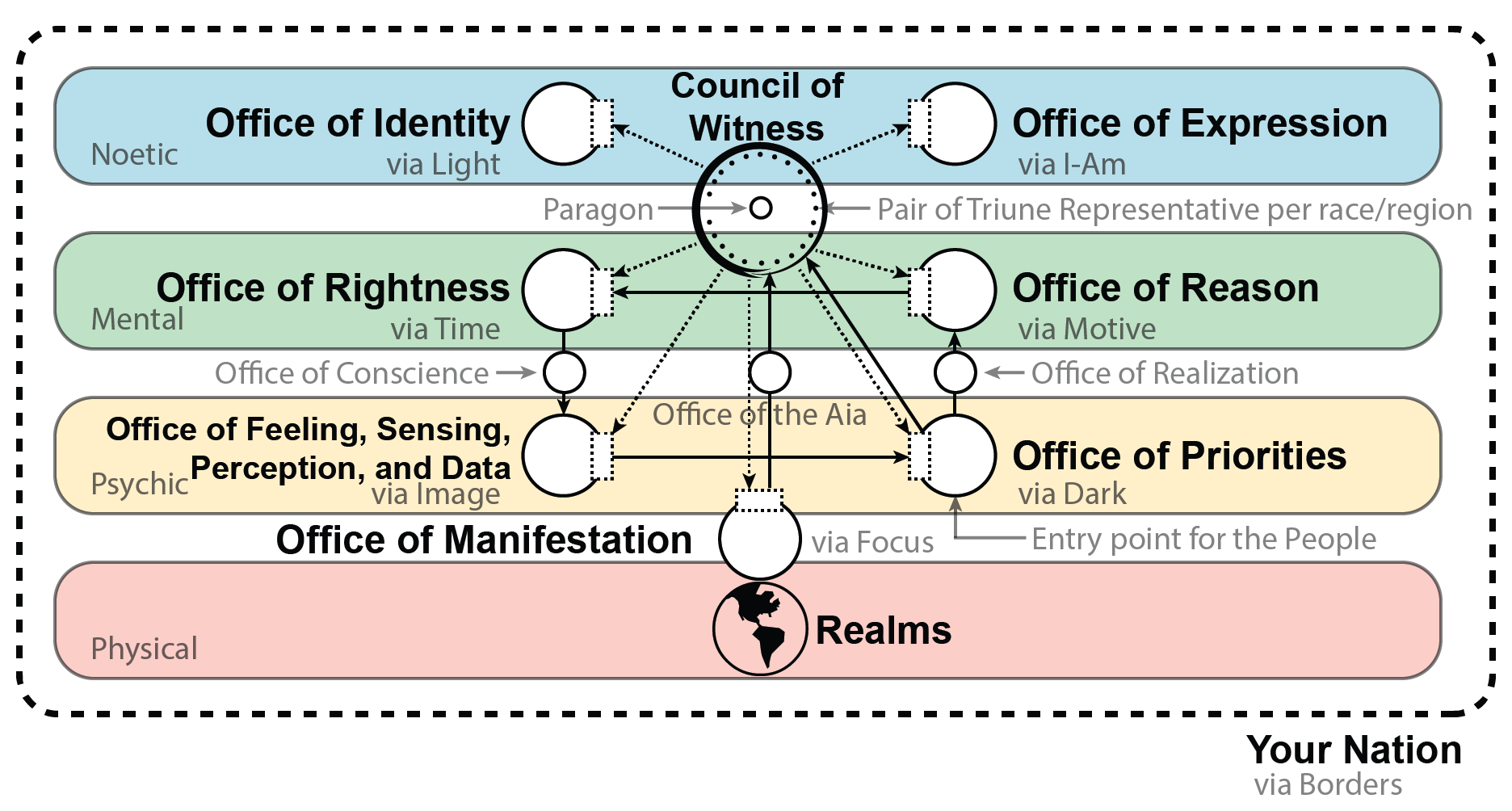
A Triune Democracy has 7 main offices and a council.
How Does a Triune Democracy Work?
-
You bring the change you want to see by making proposals and submitting them to the Office of Priorities.
In this office are all functions related to prioritizing and co-ordinating the desires of the people at scale, including but not limited to triaging, grouping, sorting, collating, filtering, rejecting, and facilitating debates, deliberations, presentations, referendums, and compromises.
You may observe and intervene on other proposals if you have concerns.
Sometimes there will be votes, but most times it is unnecessary.
-
Proposals make their way to the Office of Reason next, where they are analyzed for initial implementation approaches, reasonableness, balance, and indexed against all known and unknown thoughts and their laws.
This indexing is an important function to set up for the next office.
Balancing means to use the Law of Thought to solve for paradoxes inherent in some proposals, to take the thinking behind the proposal to a higher tier, and from that tier aim the proposal in a more conscious and balanced way.
This function is unique to Triune Democracies.
-
The Office of Rightness is the third stop for a proposal. This office evaluates whether or not the proposal will cause harm.
It looks at harm to the people, harm to the environment, harm to treaties, and so forth, and adds a note to the proposal if it causes harm.
If a proposal would cause harm, it should be revised, or could be rejected.
Where harm cannot be determined, this office can facilitate a simulation of the proposal on a small scale with the consent of everyone involved to see how it works.
-
The next office is the Office of Feeling, Sensing, Perception, and Data.
This office gauges how the proposal would impact the people affected and collects information about their sentiment, it tests the proposal for quality and to derive unknown data such as unmet needs, and it can gather additional data from various sources as needed (environment, scientific studies, allies, etc.).
-
Your proposal then returns to the Office of Priorities. If it is considered matured, it will advance to the Council of Witness. Otherwise, the cycle repeats again until the proposal matures, is rejected, or is abandoned.
Cycle?
A Triune Democracy uses an heuristic loop of core functions to process proposals.
This loop matches the proper functioning of your thinking process.
As proposals are processed through the system, they are refined, tested, and focused, so that their end result is reasonable, right, conscionable, and balanced.
The processing is a result of the Offices performing their functions without intervention by the people, and it is in this processing loop that the system can be said to be automated.
(Note: this automation does not require computers nor A.I., and Triune Democracies are people-powered systems).
Council of Witness
Symbolically representing the witnessing part of your self, the Council of Witness is made up of the best man and woman from twelve representation groups (by race, region, great house, etc.).
It has a total size of 24 Triune Representatives.
Each group can choose the manner in which they send their people to Council (creating potentially a 2D democracy).
The Council performs a representation function for all the people in the society and in this capacity it must be balanced in its composition.
It witnesses the passing of every proposal so it knows what is going on in the society. It is also the main leadership center for a Triune Democracy and performs long-term planning functions.
Ascent
- When a proposal matures, it is sent to the Council of Witness. At this point, it is guaranteed to be reasonable, right, conscionable, and balanced.
- Council performs a final check of the proposal for each representation group to ensure it doesn't harm them. It also decides if it wants the society to proceed in this direction.
- Council must commit unanimous consent for a proposal to advance to the Office of Manifestation for implementation.
-
The Office of Manifestation brings a proposal into reality through various means, the most common of which is by placing contracts on the market to be picked up by contractors and businesses.
The same procedure applies to legislation, where legislation applies.
Head of State
The head of state in a Triune Democracy is a Paragon.
This position does require passing the most extreme tests of character and knowlege as the entire system can potentially be in their hands and they must be qualified.
The Paragon does not participate in normal proposal processing and only serves to make changes to the system.
Systemic changes (or "constitutional amendments") cannot be done without a Paragon.
A rock-paper-scissors dynamic exists between the Paragon, Council of Witness, and the Office of Identity to ensure these three offices never become corrupt.
The Office of Identity is a constitutional office.
The Paragon occupies a special 25th seat on Council, but that seat is expected to be vacant most of the time.
Sovereignty
One of the goals of a Triune Democracy is to facilitate self-sovereignty among as many people as possible.
Technically, there is no such thing as self-sovereignty. Try claiming you are self-sovereign while being pillaged by marauders -- that won't work.
In a Triune Democracy, the body-politic is cast as wide as possible so that as many people can be counted among the sovereignty as desired.
This is built into the system and cannot be changed -- if you can make a proposal, the system needs you in order to function, and therefore you are sovereign.
With sovereignty comes immunity, but to get that, you have to be responsible. Maximum freedom goes hand-in-hand with maximum responsibility; it is a 1-to-1 relationship.
Although it is a system of governance, a Triune Democracy is meant to *assist* the sovereign among its society.
It would be an error to let the system do your thinking for you or to be governed by it.
But, there are still those for which this dream is unattainable, and they will be governed like in any other society, except in a Triune Democracy: they won't be harmed by their government, and they have the potential to uplift themselves out of the governed class into self-sovereignty.
Leadership
Leadership originates from wherever is closest to the needs of the society.
Often this will come from the people.
A Triune Democracy aggregates all those needs together and points society in the right direction.
Leadership can also occur from Council, who tends to focus on more stately matters, and have the facilities to chart long-term courses for the society.
Council leads by making proposals, the same as everyone else.
Representation & Participation
Although technically a direct democracy, Triune Democracies facilitate representation through the Council of Witness.
In combination with the processing loop above, this feature allows your voice to be heard without voting on every proposal, thus doing away with a major weakness of direct democracies while simultaneously solving a trilemma problem with them.
Participation among the people is enabled by making proposals, intervening in proposals, proactive consultation by the Office of Feeling, Sensing, Perception and Data, participating in debates, referendums, presentations, and votes, and observing and interacting with the Offices and Council as they work.
Democracy
Democracy means "rule by the people" and it is a misunderstanding to interpret democracy as majority rule.
In a democracy, the people form the body-politic and from that position have the ability to manage their society.
Triune Democracies present a way for the people to manage their society without the ills of majority rule.
It is possible for the majority to be wrong about something.
As well, there is greater emphasis on the self-rule, self-control, and self-governing aspect of personal development, and it is only under this condition that democracy can flourish.
Triune Democracy Facts
- Classification: Automated direct democracy
- Head of State: Paragon
- Main Office Count: 7 + Council
- Minimum Size: 6 people at local level, 36 people at societal level
- Cost: Less than representative democracy, but advise re-investing saved money into Offices
-
Efficiency:
- Leaner than representative democracy without loss of function
- Smoother than other direct democracies due to automation
- Elections: Council of Witness, lower Office of Manifestation positions
- Transparency Model: Open (public may view, observe, access, inspect every office and Council at will)
There is no royal lineage, no family dynasties, and no party politics in a Triune Democracy. It truly is a system for the people.
Triune Democracy is, by far, the most advanced democratic system ever conceived and a very important piece to a much larger new paradigm.